The Gaze That Doesn't Resolve.
On Holzer, Sartre, and the ethics of looking slowly
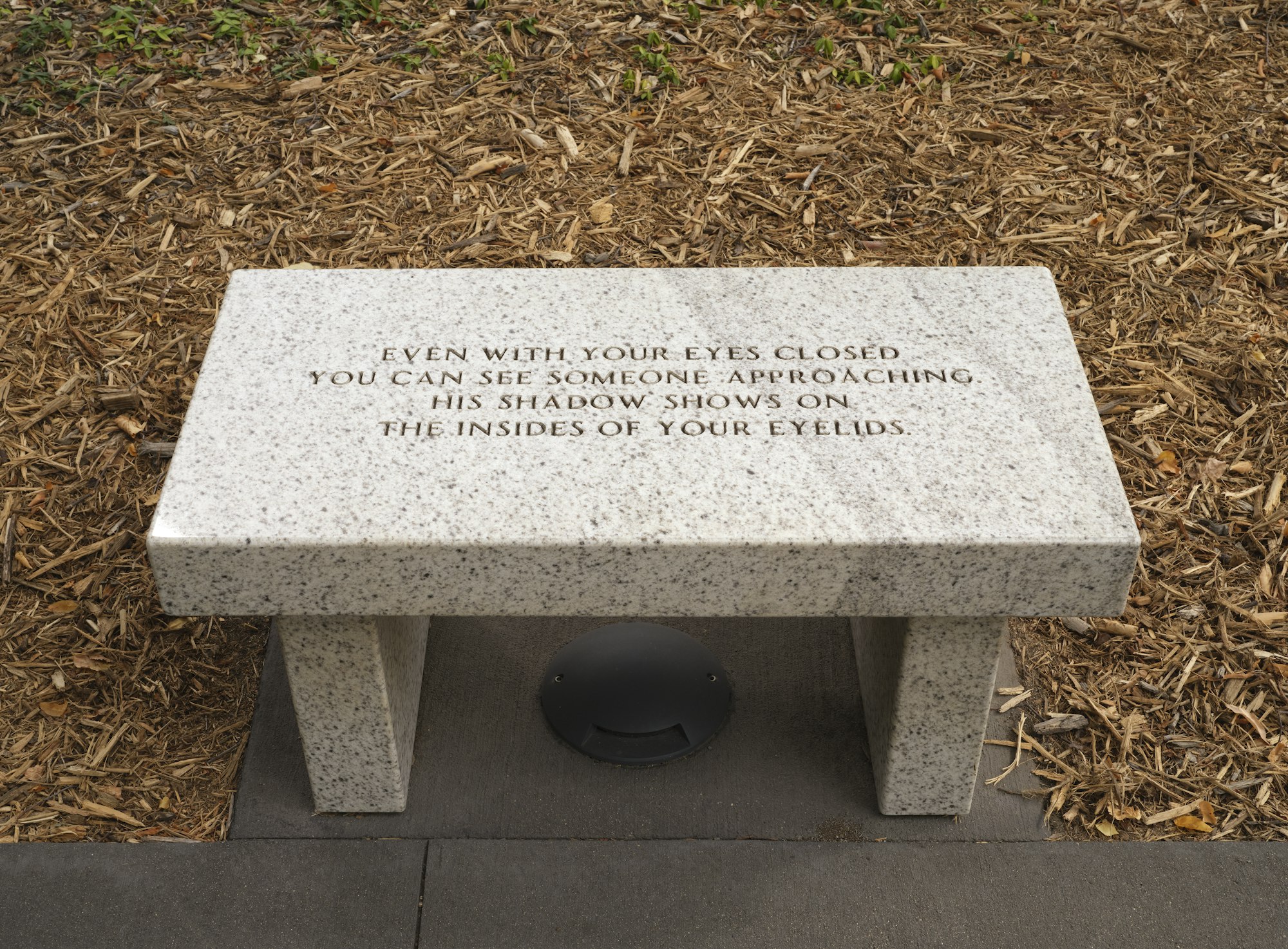
Somewhere in New York in 1977, a sentence appeared on a wall with no signature beneath it. You are a victim of the rules you live by. Then another. Abuse of power comes as no surprise. Then another, and another: declarative, authorless, addressed to no one and therefore to everyone who passed. Jenny Holzer called them Truisms, though the word is deliberately ironic. These were not truths so much as truth-shapes: statements that wore the grammar of certainty while quietly evacuating its content. You read them and felt, briefly, seen. Then you felt accused. Then you weren't sure what you felt, and you kept walking, carrying the sentence with you like a stone in a coat pocket.
This is a particular kind of looking, or rather, being looked at. The Truisms don't describe the world; they address you inside it. They find you in the act of passing and refuse to let the passing be neutral. For a moment, the usual transaction of looking is reversed: instead of you apprehending the image, the image apprehends you.
Jean-Paul Sartre understood this reversal as one of the fundamental anxieties of human existence. In Being and Nothingness, he describes the experience of le regard: the look; as the moment when another consciousness becomes aware of you, and in becoming aware, fixes you. To be looked at is to be made into an object in someone else's world. You are no longer the subject of your own experience; you are a character in theirs. This is why we flinch when we realise we are being watched. It is not vanity. It is the sudden awareness of being seen from outside. Of having, for a moment, a shape we cannot see ourselves.
What Sartre identified as an existential condition, we have since engineered into an infrastructure. The image feed is le regard made systematic: everything looked at, everything briefly fixed, everything metabolised and scrolled past. We consume images at a rate that would have been incomprehensible to any previous generation, and we do it with a particular kind of attention: skimming, categorising, responding with a gesture so small it barely registers as a choice. The like. The share. The pause of one and a half seconds before the next thing arrives.
This is not looking. It is processing. And the difference matters more than we have yet allowed ourselves to admit.
Emmanuel Levinas, writing against Sartre's bleaker conclusions, proposed that genuine encounter begins precisely where the fixing impulse fails. The face of the other, he argued, is the one thing that cannot be fully reduced to an object of knowledge. To look at a face, to truly look, without the protective apparatus of category and judgement, is to receive a demand: do not reduce me. The ethical relationship is not one of mastery but of surrender to the unresolvable particularity of another being. You cannot look at someone this way and remain unchanged. You cannot scroll past them.
What Levinas saw in the face, certain works of art still manage to enact. Not all art. Much of it has made its own peace with the speed of contemporary attention, offering itself up in forms designed for quick apprehension and easy circulation. But some works resist this. They require duration. They give you nothing in the first seconds, and everything in the tenth minute, and something else entirely if you return the following week. They refuse to be finished with.
Holzer's sentences do this in miniature. Protect Me From What I Want. You think you understand it immediately. Irony, desire, self-destruction. And then it stays with you, and the meaning shifts, and you realise it was never quite saying what you thought. The sentence looks back. It remains open.
This is what looking slowly means: not the affectation of lingering, but the willingness to remain in uncertainty long enough for a thing to change in front of you. To resist the closure that understanding too quickly provides. Sartre's regard fixes; Levinas's encounter opens. The difference is not a matter of time exactly, but of intention, of whether you approach a thing in order to possess it or in order to be altered by it.
We are losing this capacity. Not through any single failure but through the accumulated pressure of an attention economy that rewards speed and punishes difficulty, that makes frictionlessness the highest virtue and asks of every image only that it yield itself immediately. The images comply. They are made, increasingly, for compliance.
What remains, what has always remained, and will remain; is the work that refuses. The painting whose surface takes time to enter. The sentence on a wall that follows you home. The essay that asks you to hold two incompatible ideas simultaneously and does not resolve them into a third, tidier thing. These are not nostalgic forms. They are formal acts of resistance to a particular kind of violence: the violence of the gaze that fixes, that consumes, that moves on.
To practise the gaze that doesn't resolve is to accept that looking is not a passive act but an ethical one. That what you choose to look at, and how long, and with what quality of attention, is not a matter of taste but of character. That slowness is not the opposite of engagement but its deepest form.
Holzer knew this. She put language in the street, and made it demand contemplation. The Truisms work because they refuse the terms of their own context. They appear where things move fast and insist on being carried slowly.
This journal begins from the same insistence. One essay, a small gathering of things worth holding. Nothing that asks only to be consumed. Everything that asks, in some measure, to be dwelt in.
We begin here, with a sentence on a wall, and the particular unease of feeling seen.