The Portal.
On nostalgia, Latin music, and the small human details of a place
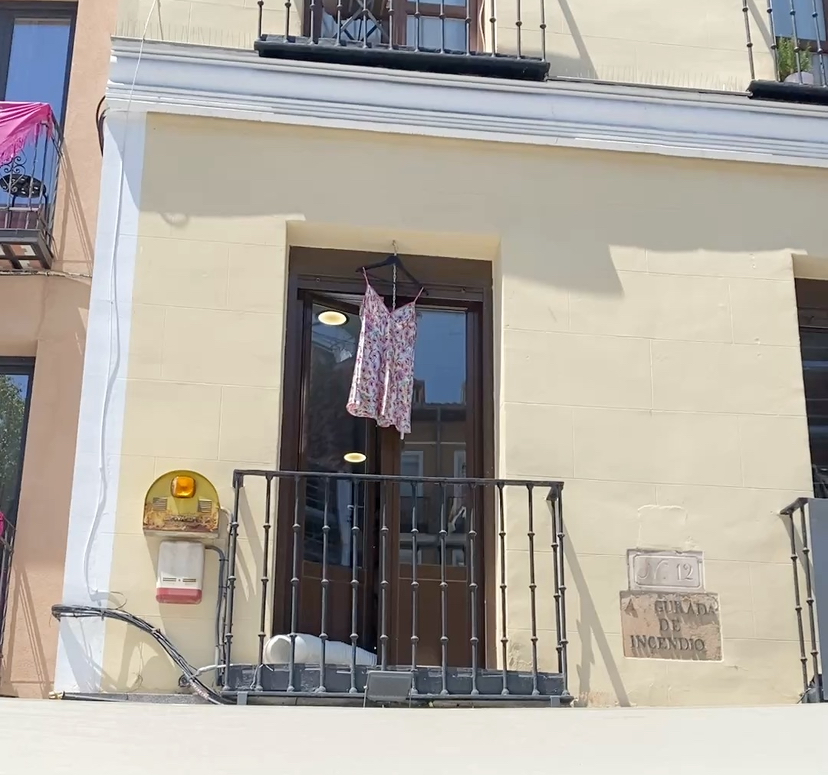
There is a bar in El Raval, Barcelona where we sat for two hours on a Monday evening; my mother, my sister, and I, doing a crossword and chatting over some patatas bravas. The tiles were the colour of old bone. The barman moved with the particular unhurriedness of someone who has decided, at some earlier point in his life, that speed is not a virtue. He brought us vermut without asking if we wanted it, because of course we did; with extra olives. Outside, a woman passed the window three times with her dog. Not impatient, just elsewhere.
I did not take a photograph. I am glad I did not take a photograph.
What I noticed, sitting there, was something underneath the noticing; a particular quality of aliveness that arrived without warning and settled in my chest. Not happiness exactly, though it was that too. Something more like recognition. As though a frequency I had forgotten I could receive had suddenly been tuned back in.
The Spanish language does this to me. Not because I am Spanish (I am not) but because I grew up in and around Latin cultures, moving, accumulating languages and gestures and ways of standing in a room that belong to places I have technically left. When I hear Spanish spoken at speed in a street, when I hear a certain kind of music coming from somewhere I cannot quite locate, something in me responds before I have had time to think about it. The body knows first. The mind arrives later, a little breathless, to find the door already open.
Proust called this involuntary memory: the past arriving not through effort but through the senses, unbidden and complete. His famous madeleine dipped in tea is almost too well-known to use here, except that the experience he describes is so precisely what I mean: the taste does not remind you of the past; it is the past, delivered whole into the present moment, as vivid and disorienting as a dream you remember in the middle of the day. The sound of a language can do this. So can music. So can the way afternoon light falls on terracotta at a particular hour. So can the warmth of a room where nobody is in a hurry.
Svetlana Boym, the cultural theorist who gave us the most precise taxonomy of nostalgia we have, distinguished between two kinds: restorative and reflective. Restorative nostalgia, she argued, is the dangerous kind. The kind that seeks to reconstruct the past as it was, or as we imagine it was, erasing its complexity in favour of a simpler, more useful myth. It is the nostalgia of political movements, of national fantasies, of the belief that something was once whole and has since been broken and can be repaired if only we return to it. It is, as she put it, a romance with one's own fantasy.
Reflective nostalgia is something else entirely. It does not seek to return. It does not believe return is possible, or even desirable. It lingers instead in the fragmentation; in the gap between the past as it was and the past as it lives in you, knowing the two are not the same and finding something true in that difference. It is comfortable with incompleteness. It mourns without demanding resolution. It is, in Boym's phrase, about the algia: the longing itself, rather than the nostos: the homecoming.
What I felt in that bar in Barcelona was reflective nostalgia. Not a wish to go back to any particular time or place, but a recognition that some part of me was formed in the register of Latin culture. In its tempo, its warmth, its specific relationship to time and voice and the street; and that part had not gone anywhere. It had simply been waiting for the right frequency.
Sylvia Plath wrote in her journals about the way certain places press themselves into you. Not their monuments or their famous views, but their textures, their moods, the specific temperature of their air. She was acutely sensitive to the sensation of being in a place, the way a city could feel like a state of mind, the way a room could hold an atmosphere that was almost biological in its immediacy. She understood that travel was not about distance but about depth: the way being somewhere else allows you to see yourself from outside yourself, briefly, before the new place becomes ordinary too.
Murakami understood something similar, though he arrived at it differently. In Norwegian Wood, memory is not something that happens to the narrator; it is what he is, the material from which he has been made. His protagonist cannot move through the present without the past pressing up through it, like water through stone. The novel is saturated with the textures of a specific time and place, and yet it is not nostalgic in the restorative sense; it does not want to return. It simply cannot forget. There is a difference, and it matters: one is a demand, the other a condition.
The small human details of a place are where this understanding lives. Not the museum, though the museum may be beautiful. Not the cathedral, though the cathedral may change you. The old man in the corner of the bar who is drinking his tinto de verano, who orders the same thing he always orders, who nods at the waitress in a way that contains an entire history. The child who has fallen asleep across three plastic chairs at the bar, entirely undignified, entirely at peace.
These are the things you carry.
My mother noticed the old man in the restaurant. My sister heard the music before I did, she always does. We were three women in a city that did not know us, and for an afternoon we were also three versions of the same person at different points in her life, watching each other notice things. This is perhaps the deepest form of reflective nostalgia: not the longing for a place or a time, but the sudden recognition that the people you are with contain your history, that the distance between who you were and who you are is held, quietly and without drama, in the way your mother laughs at something or the way your sister tilts her head when she is listening.
The portal is not to another time. It is to another version of yourself; one you had not lost, exactly, but had not visited in a while.
We finished the vermut. The barman did not rush us. Outside, it had started to get dark and the city air was still thick with warmth and noise.
I did not need to understand what they were saying. I understood what they were saying.